


D6AC is an ultra-high strength, quench-and-tempered alloy steel originally developed for aerospace and defense applications. It is used in rocket motor cases, aircraft landing gear, high-pressure gas cylinders, and other components where the combination of very high strength and adequate toughness is critical. Unlike more common grades such as 4340 or 300M, D6AC is less widely stocked, and procurement mistakes are expensive.
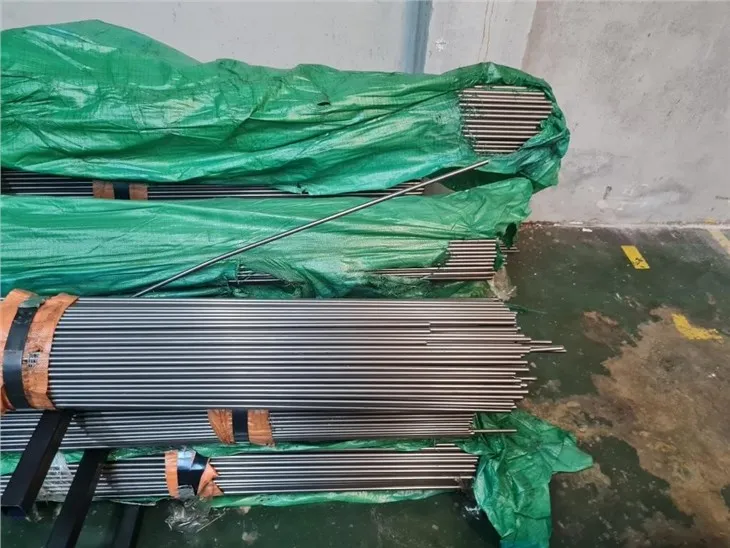
What Is D6AC Steel?
D6AC is a medium-carbon, chromium-nickel-molybdenum-vanadium steel. It is typically supplied in the hot-rolled black surface condition and then quenched and tempered by the customer or a heat treater. The grade is known for its high hardenability, good fatigue resistance, and ability to maintain toughness at strength levels above 1,000 MPa.
Chemical Composition and Gas Content Requirements
A typical D6AC heat shows approximately:
| Element | Typical MTC Value (wt.%) |
|---|---|
| C | 0.48 |
| Si | 0.21 |
| Mn | 0.73 |
| P | 0.009 |
| S | 0.003 |
| Cr | 1.00 |
| Ni | 0.57 |
| Mo | 0.94 |
| Cu | 0.13 |
| V | 0.006 |
| Pb | 0.00 |
| Sn | 0.00 |
Gas content is a critical acceptance criterion for D6AC, especially in aerospace and pressure vessel applications. A typical MTC may report:
| Gas | Typical Value |
|---|---|
| Oxygen (O) | 23 ppm |
| Nitrogen (N) | 48 ppm |
| Hydrogen (H) | 0.9 ppm |
These low levels are achieved through vacuum degassing or electroslag remelting. Buyers should confirm the melting route and gas content on the certificate, not just the chemistry.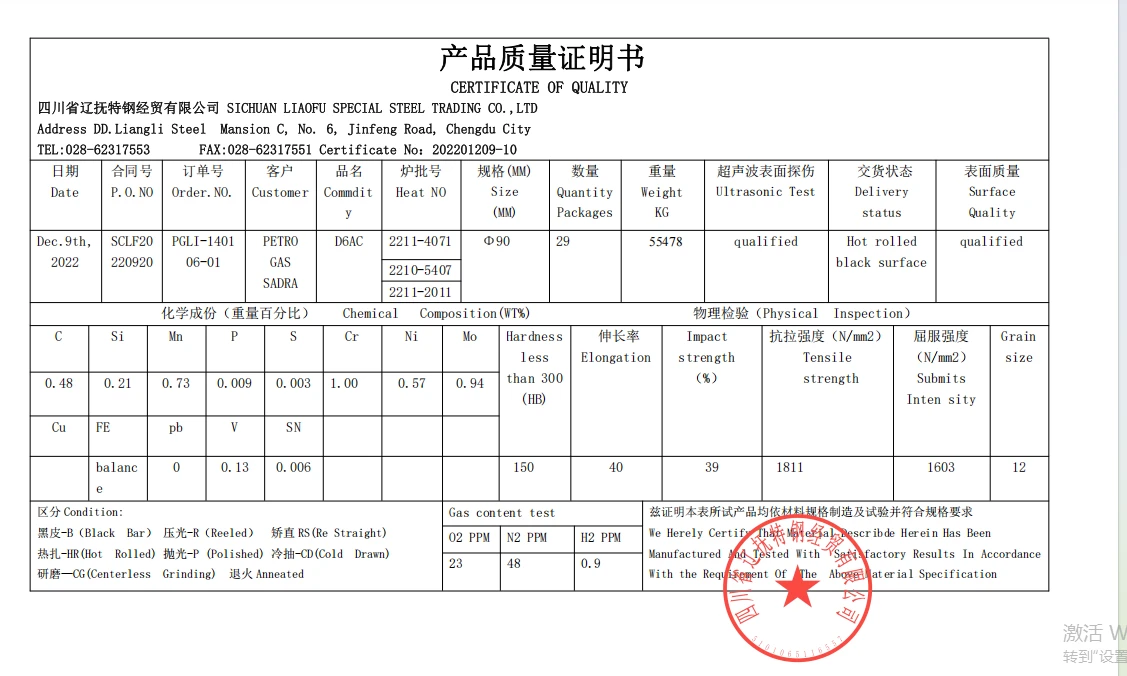
Mechanical Properties After Quenching and Tempering
In the quenched and tempered condition, D6AC round bar typically achieves:
| Property | Typical Value |
|---|---|
| Tensile strength | ≥ 1,116 MPa |
| Yield strength | ≥ 1,032 MPa |
| Elongation | 15% |
| Impact energy | ≥ 40 J |
| Hardness | < 300 HB |
| Grain size | ASTM 8 or finer |
The exact properties depend on the tempering temperature and section size. For critical applications, the purchaser should specify the required strength range and impact test temperature.
Why Cleanliness and Gas Content Matter
D6AC is often used in thin-wall, high-stress structures. Non-metallic inclusions and hydrogen embrittlement can initiate cracks that lead to catastrophic failure. This is why gas content and inclusion ratings are specified on the MTC. A certificate that only lists tensile strength is not sufficient for aerospace or pressure vessel use.
Machining, Welding, and Heat Treatment Notes
D6AC in the annealed or hot-rolled condition can be machined with carbide tooling. After quenching and tempering, machining becomes more difficult, and grinding may be required for tight tolerances.
Welding of D6AC is possible but requires preheat and post-weld heat treatment. In many aerospace applications, welding is avoided in favor of mechanical fastening or integral machining.
Heat treatment should follow the material supplier's or customer's specification. Typical austenitizing temperature is around 870–900°C, followed by oil quench and tempering in the 200–600°C range, depending on the target strength and toughness.
Typical Applications
- Rocket motor cases
- Aircraft landing gear components
- High-pressure gas cylinders
- Missile structures
- Heavy-duty dies and tooling
Procurement Checklist for D6AC Round Bar
- Confirm melting route (vacuum degassed, ESR, or VAR)
- Verify gas content: O, N, H
- Check grain size and inclusion rating
- Confirm heat treatment condition and mechanical properties
- Match heat number on the bar to the MTC
- Request ultrasonic inspection if the application is critical
- Confirm surface condition (black, peeled, or ground)
Sichuan Liaofu Special Steel Trading Co., Ltd. supplies D6AC round bar sourced from approved Chinese mills. We do not produce steel or operate a laboratory. All data comes from the original mill MTC, and every shipment is fully traceable.
FAQ
Q: What is D6AC equivalent to?
A: D6AC has no exact single equivalent. It is often compared with 300M and 4340, but its vanadium content and gas cleanliness requirements make it a distinct grade. Always specify D6AC by name and standard on your RFQ.
Q: Why is gas content specified on the D6AC MTC?
A: D6AC is used in high-stress, thin-wall structures where hydrogen, oxygen, and nitrogen can cause embrittlement or crack initiation. The MTC should report O, N, and H values so you can verify cleanliness before accepting the material.
Q: Can D6AC be welded?
A: Yes, but it requires preheat and post-weld heat treatment. In many aerospace applications, welding is avoided. Confirm the welding procedure with your engineering team before processing.
Q: What delivery condition do you supply D6AC in?
A: We typically supply D6AC in the hot-rolled black surface condition. Other conditions can be requested depending on the mill's capability and your requirements.
Q: Do you provide ultrasonic inspection for D6AC?
A: We can request ultrasonic inspection from the producing mill. We do not perform inspection ourselves. If third-party inspection is required, we can arrange it.
Q: Are you a steel mill or a trading company?
A: We are a trading company. Sichuan Liaofu does not melt steel, does not operate an in-house laboratory, and does not generate independent test data. All performance data comes from the producing mill's original documentation.