


Compare 35NCD16 (1.6773) and ASTM 9160C for large-section parts. Avoid cross-standard substitution risks and learn EU vs North America UT acceptance criteria.
Procuring steel for large-section parts (heavy shafts, massive gears, or large tooling) carries a unique set of risks. The real danger is not paying a slightly higher price; it is machining a 300mm block, sending it for heat treatment, and discovering the core failed to harden, or that the ultrasonic testing (UT) rejects it due to center segregation.
When specifying 35NCD16 alloy steel round bar, buyers must look beyond the chemistry table. The approval of your mill test certificate (MTC), the required testing standards, and the legality of grade substitution are what actually protect your project timeline.


35NCD16 vs 9160C: The EU and North America Standard Gap
Buyers often treat 35NCD16 (AFNOR), 1.6773 (DIN), and 9160C (ASTM) as direct drop-in replacements. In reality, the regional acceptance criteria differ significantly.
- For European buyers, heavy machinery and wind energy projects typically mandate AFNOR 35NCD16 with strict EN 10228-3 UT standards and full REACH compliance. Many EU engineering firms will reject an ASTM 9160C certificate for a 35NCD16 drawing, even if the chemical composition matches perfectly.
- For North American buyers, ASTM 9160C is standard, but buyers in oil & gas or heavy gearing often require independent third-party witness testing alongside the ASTM E2375 UT report.
Why Substitution Fails: The Hardenability Factor
The reason large sections require this specific grade is due to the size effect. Standard alloy steels (like 4140 or 4340) lose hardenability as the diameter increases. A steel that reaches 50 HRC at 50mm might only reach 25 HRC at 300mm.
35NCD16 uses a higher nickel (3.5–4.2%) and chromium (1.6–2.0%) content to guarantee deep through-hardening. If a supplier tries to substitute 9160C with a generic 4340 variant, the core properties will likely fall below the required 1030 MPa yield strength.
Note: To see how we control this melting process at the source, read our in-house ESR capacity update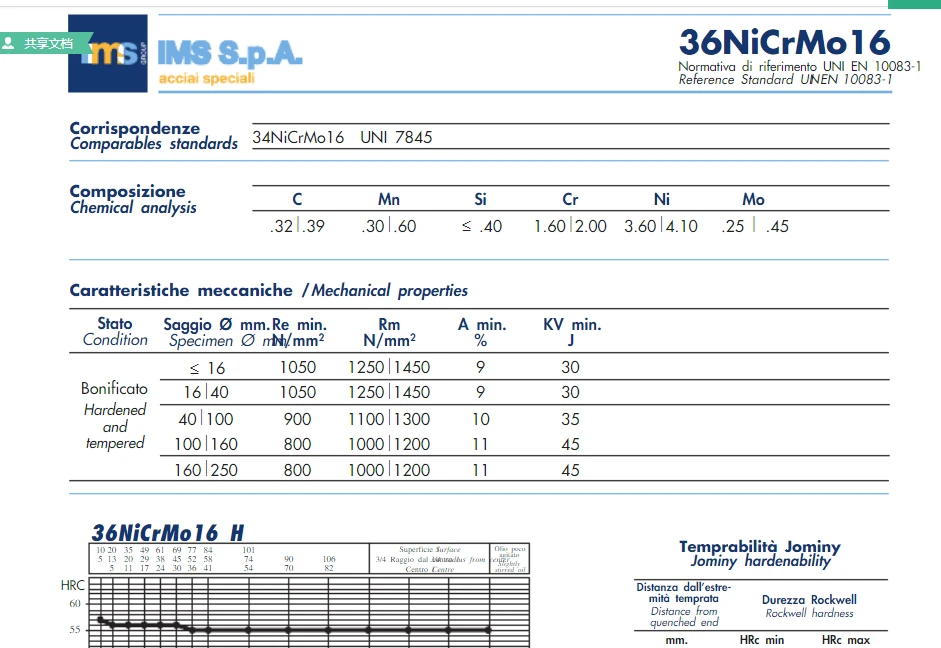
Acceptance Criteria: EN 10228-3 vs ASTM E2375
The most common dispute in large-section procurement is UT rejection.
- EU Projects (EN 10228-3): Often requires stringent quality classes (e.g., Class 2 or 3) for critical heavy forgings, with zero tolerance for certain inclusion clusters.
- NA Projects (ASTM E2375): Focuses on specific probe frequencies and amplitude responses, often requiring the mill to hold specific ASME or API approvals.
You must specify the exact UT standard and acceptance class on the Purchase Order, not just on the drawing.
PO Checklist Before You Buy
- Specify the exact grade: 35NCD16 vs 9160C (do not leave it open to supplier interpretation).
- Require ESR (Electroslag Remelting) if the section exceeds 150mm to prevent core segregation.
- State the exact UT standard (EN 10228-3 or ASTM E2375) and acceptance level.
- Request a sample MTC to verify the heat treatment (Q+T) and core mechanical properties.
- For EU tenders, confirm the inclusion of REACH and heat traceability documentation.
FAQ
Q: Can I use ASTM 9160C as a direct substitute for AFNOR 35NCD16?
A: Chemically they are similar, but for European projects, the answer is usually no. The UT standards (EN vs. ASTM) and certification traceability requirements often make 9160C unacceptable for an EU drawing.
Q: Why does my 35NCD16 core fail to reach the required hardness?
A: This usually happens if the mill supplied standard air-melted steel instead of ESR-melted steel for a large ingot, or if the quenching rate was too slow for the section size.
Q: Is EN 10228-3 the same as ASTM E2375?
A: No. They are different testing methodologies with different acceptance criteria. You must specify the one required by your end customer's engineering standard.