

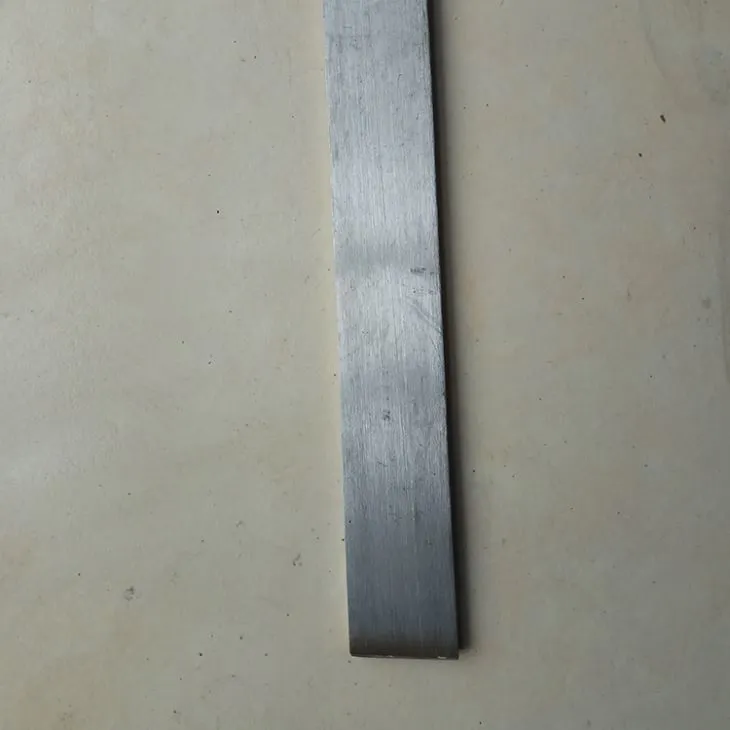
Our objective will be to research and develop new products, continue to innovate, strive for perfection and deliver better 52100 Bearing Steel Bar, 1.3343 High Speed Steel Flat Bar, 430 Stainless Steel Bar to customers around the world. Trust us and you'll gain far more. Welcome to negotiate! Our company has the competitive advantage of high service quality and complete marketing channel structure, and is in a leading position in the industry. To formulate a strategic, open, policy and operational information development plan is the prerequisite for our company's scientific development.
Introduction
AISI 321/JIS SUS321 Austenite heat resistant stainless steel bar.
Type 321 stainless steel is Ni - Cr – Ti austenitic stainless steel, its performance is very similar with 304, but due to join the metal titanium, make it have better grain boundary corrosion resistance and high temperature strength. Because of adding titanium, make its effective control the formation of chromium carbide.
321 stainless steel has excellent high temperature Stress Rupture (Stress Rupture) properties and high temperature Creep Resistance (Creep to hold) Stress and mechanical properties are better than that of 304 stainless steel.
Standards: ASTM, JIS, GB, EN (DIN, BS, NF) Or Per as clients’ requires.
321 shows good corrosion resistance in natural environmental media (rural waters and industrial atmospheres) and most diluted organic acids at moderate temperatures, but does not perform well in more corrosive media such as chlorine solutions or sulfuric acid. AISI 321 is less machinable, but can be easily welded by most standard processes and does not require post-weld heat treatment.
321 Stainless Steel Applications
Ideal uses for 321 stainless steel include expansion joints, aircraft parts, furnace parts, heat exchangers, mineral processing screens, all standard methods of welding, with or without filler metal.

Product Basic Information:
Material | ASTM 321 | ||
Chemical Composition | Mechanical Properties(In Quenched & Tempered State) 565 °C | ||
C | <0.12 | Tensile strength(MPA) | 205 |
Si | <1.00 | Yield strength (MPA) | 540 |
Mn | <2.00 | Elongation(δ5/%) | 40 |
Cr | 17.00-19.00 | Reduction in Area (ψ/%) | 50 |
Mo | - | Impact (J)v | -- |
P | ≤0.035 | Hardness | <187 |
S | ≤0..030 | ||
N | 0.35-0.50 | ||
Ni | 8.00-11.00 | ||
Similar steel grade & equivalent steel materials:
USA | Japanese | Gemany | British | France | International | Chinese |
ASTM&AISI&SAE | JIS | EN DIN | EN BS | EN NF | ISO | GB |
321 | SUS321 | X6CrNiTi18-10(1.4541) | ------ | 1Cr18Ni9Ti |

Seamless steel pipe process:
The production process of general seamless steel tubes can be divided into two types: cold-drawn and hot-rolled. The production process of cold-rolled seamless steel tubes is generally more complicated than hot-rolled. The tube blank must first be subjected to three-roll continuous rolling, and then extruded. In the sizing test, if the surface does not respond to cracks, the round pipe is cut by a cutter and cut into a blank of about one meter in length. Then enter the annealing process. Annealing must be acid-washed with an acidic liquid. When pickling, pay attention to whether there is a large amount of blistering on the surface. If there is a large amount of blistering, the quality of the steel pipe cannot meet the response standard. The appearance of cold-rolled seamless steel pipe is shorter than that of hot-rolled seamless steel pipe. The thickness of cold-rolled seamless steel pipe is generally smaller than that of hot-rolled seamless steel pipe, but the surface looks brighter than thick-walled seamless steel pipe. It's rough, and it doesn't have too much burr. The hot-rolled seamless steel pipe is generally delivered in the hot-rolled state after heat treatment. Hot-rolled seamless steel pipes are subject to strict manual selection by the staff after quality inspection. After the quality inspection, the surface is oiled, followed by multiple cold-drawing experiments. After the hot-rolling treatment, a perforation experiment is performed. If the diameter of the perforation is too large, straightening correction is required. After straightening, it is transferred to the flaw detector by the conveying device for flaw detection experiments. Finally, the labels are labeled and the specifications are arranged and placed in the warehouse.

Our Service

Our firm aims to operating faithfully, serving to all of our consumers, and working in new technology and new machine continually for ASTM 321 316 304 309 310S Stainless Steel Rod High Temperature Resistant Stainless Steel Bar Corrosion Resistant Steel Bar. We adhere to the development concept of 'What customers want is what we do', and constantly innovate to meet the needs of the evolving market. We firmly believe in that the essence of innovative spirit is to create differentiated value.